The Triangle Shirtwaist Factory Fire: From Tragedy to Reform
Short-Term Impact
The fire sparked public outrage. Reverend Slattery said, “One of the hard facts that will confront these bereaved is that it will probably be explained that the death of their loved ones was needless. It will perhaps be discovered that someone was too eager to make money out of human energy to provide the proper safeguards and protection” (Stein, p. 134).
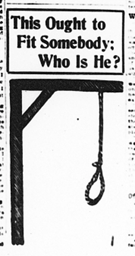
On March 27, a newspaper published a cartoon of gallows, captioned “This ought to fit somebody; who is he?” (New York Evening Journal, 1911).
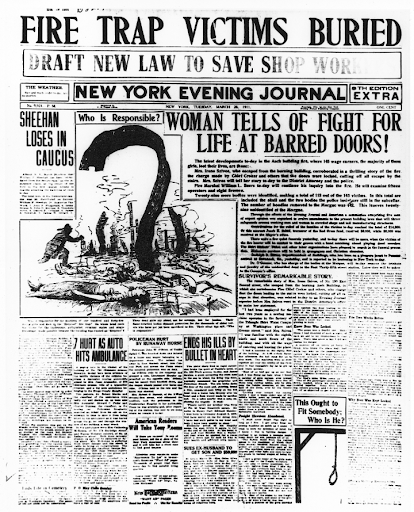
"Fire Trap Victims Buried. Draft New Law to Save Shop Workers" (New York Evening Journal, 1911).
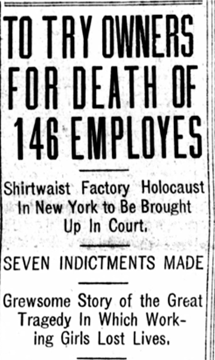
Authorities charged factory owners with manslaughter. A newspaper described the accident as the “Shirtwaist Factory Holocaust in New York” (The San Antonio Light, 1911).
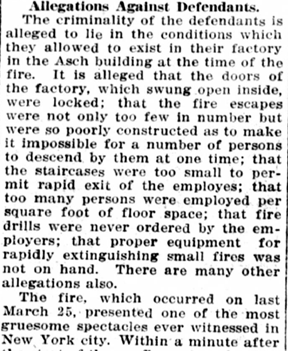
“The criminality of the defendants is alleged to lie in the conditions which they allowed to exist in their factory in the Asch building at the time of the fire. It is alleged that the doors of the factory, which swung open inside, were locked; that the fire escapes were not only too few in number but were so poorly constructed as to make it impossible for a number of persons to descend by them at one time; that the staircases were too small to permit rapid exit of the employees; that too many persons were employed per square foot of floor space; that fire drills were never ordered by the employers; that proper equipment for rapidly extinguishing small fires was not on hand. There are many other allegations also”
"Allegations Against Defendants" (San Antonio Light, 1911).
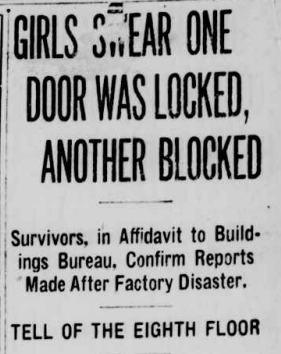
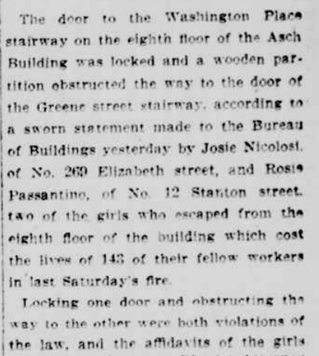
"The door to the Washington Place stairway on the eighth floor of the Asch Building was locked and a wooden partition obstructed the way to the door of the Greene street stairway, according to a sworn statement made to the Bureau of Buildings yesterday by Josie Nicolost ...."
"Locking one door and obstructing the way to the other were both violations of the law..."
“Girls Swear One Door Was Locked, Another Blocked” (New York Tribune, 1911).
Owners denied responsibility, saying architects confirmed the building met fire standards and was inspected, and claiming doors were locked to prevent theft: “we…found from two dozen to three dozen waists that these girls had taken” (Marsico, p. 51).
During the trial, Fire Chief Edward Croker was asked about exits. He confessed, “...there is only about one door on that loft you can get in”, “...Many a time the firemen get into places in the night time and there is no room for a man to go through the passages”, “The doors going to the roof are locked. They pay absolutely no attention to the fire hazard or to the protection of the employees in these buildings”. Croker mentioned, “The fault in New York City is that there is nobody responsible for anything. The Fire Department is not responsible; the Building Department is not responsible; the Police Department is not responsible; the Health Department is not responsible. If anything happens they are all stepping from under.” If each department fulfilled their duties, the outcome might have been different.
The prosecuting side argued, “On April 11, a grand jury indicted Harris and Blanck on seven counts, charging them with manslaughter in the second degree under section 80 of the Labor Code, which mandated that doors should not be locked during working hours” (Cornell, 2018).
The defense however “presented witnesses designed to show that the ninth floor deaths resulted from fire blocking the Washington Place stairwell, even though the door was actually open” (UMKC).
The owners were found not guilty.
Regarding locked doors, Deputy Fire Marshal Shea said, “A lot of industries frowned on their employees taking unwarranted breaks during their working shift. So to prevent people from walking outside, a lot of times…they would chain all the exit doors shut so they could maintain a vision of people coming and going into their place of business” (Shea, 2025).
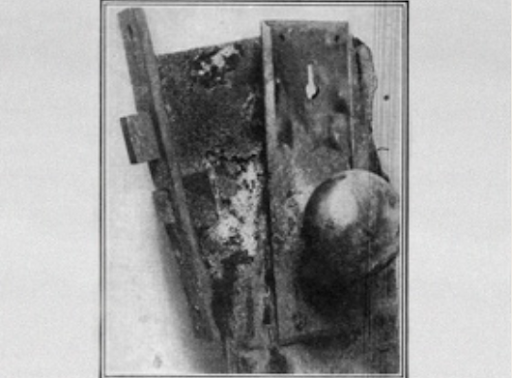
“Door handle found on the ninth floor with the bolt in the locked position” (Cornell, 2018).
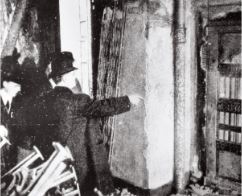
"Inspectors view one of the locked doors at the Triangle Shirtwaist Factory" (Marsico, p. 47).
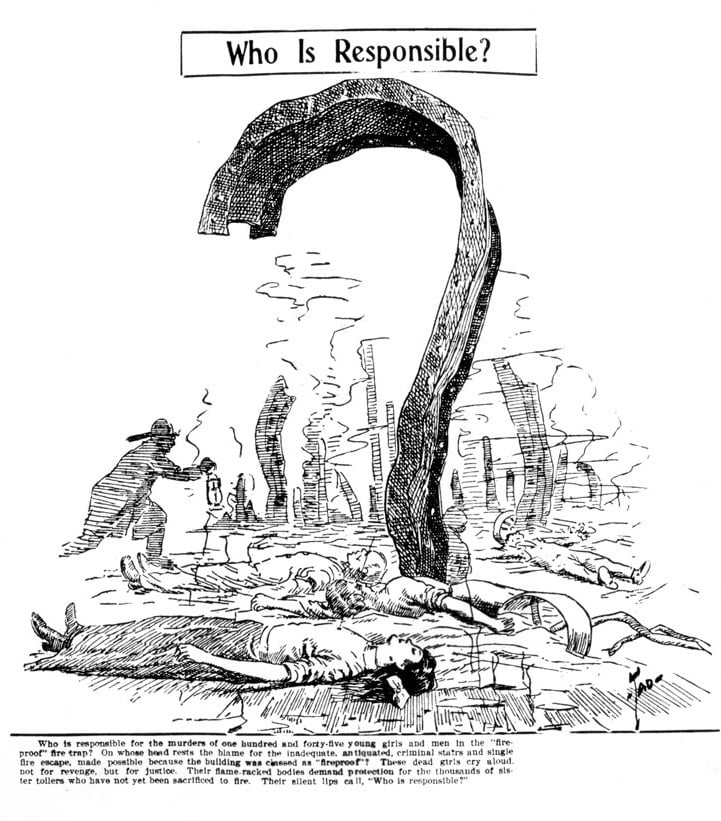
"Who is responsible? Who is responsible for the murders of one hundred and forty-five young girls and men in the ‘fire proof’ fire trap? On whose head rests the blame for the inadequate, antiquated, criminal stairs and single fire escape, made possible because the building was classed as ‘fireproof’? These dead girls cry aloud, not for revenge, but for justice. Their flame-racked bodies demand protection for the thousands of sister toilers who have not yet been sacrificed to fire. Their silent lips call, `Who is responsible?'".
"Who is Responsible?" (Dorgan, 1911).
The owners were found not responsible. One juror said, “I cannot see that anyone was responsible for the disaster. It seems to me to have been the act of the Almighty. I think that the Blanck and Harris factory was well managed. I paid great attention to the witnesses while they were on the stand. I think the girls who worked there were not as intelligent as those in other walks of life and were therefore the more susceptible to panic” (Marsico, p. 52).
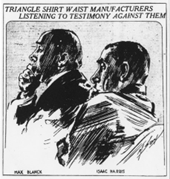
"Triangle Shirtwaist Manufacturers Listening To Testimony Against Them" (Cornell University, 1911).
In 1914, the factory owners compensated 23 families $75 per death, despite receiving $60,000 in insurance.
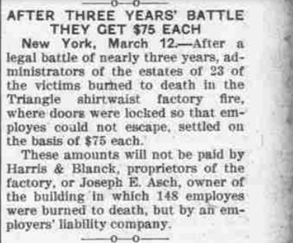
(The Day Book, March 12, 1914).
Groups, including the Women’s Trade Union League, formed a relief committee, raising $30,000 for victims
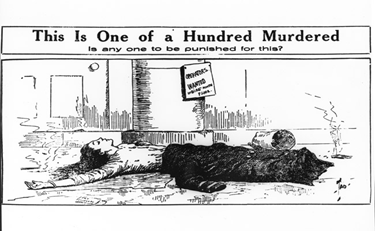
"This Is One of a Hundred Murdered. Is anyone to be punished for this?"(Dorgan, 1911).
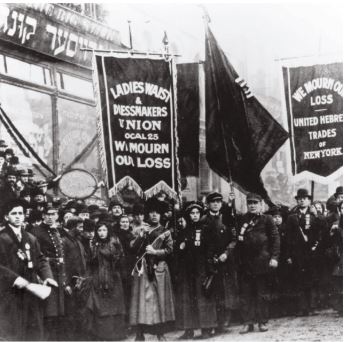
“In 1911 labor union members protest and mourn the loss of their fellow garment workers” (Marsico, p. 43).