The Triangle Shirtwaist Factory Fire: From Tragedy to Reform
The Story
Max Blanck and Isaac Harris owned the Triangle Shirtwaist Factory, occupying the 8th-10th floors of the Asch Building in New York. They employed 500 laborers, mostly young immigrant women and children, earning $6-$15 weekly
Social reformer Wirt Sikes described the working conditions: “There is no attempt at ventilation. The room is crowded with girls and women, most of whom are pale..and are being robbed of life slowly and surely… They bend over their work with aching backs and throbbing brows; sharp pains dart through their eyeballs; they breathe an atmosphere of death” (Sikes, 1868).
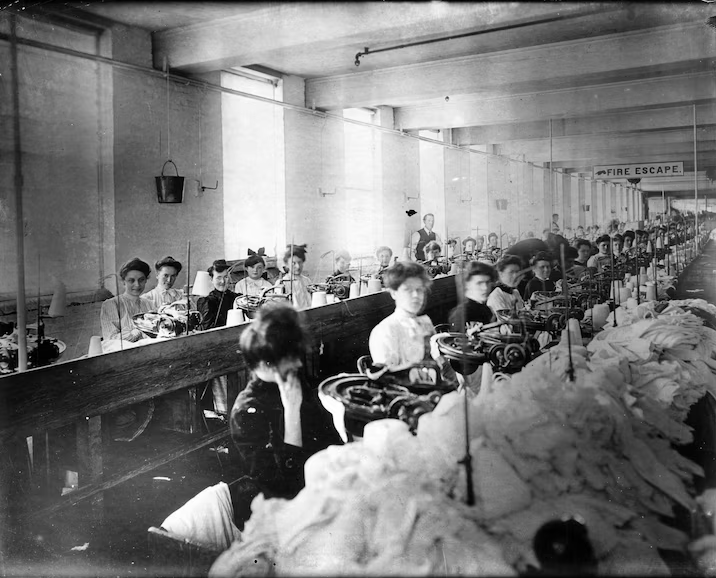
"Women operate sewing machines in a workroom similar to the Triangle Shirtwaist Factory in Greenwich Village, New York. The factory’s poor conditions contributed to the severity of the fire" (Zuma Press Inc).
Minimal breaks led to unsanitary conditions and exhaustion-related mistakes. Injuries went mostly uncompensated. Owners ignored safety, locking stairs and maintaining only one working elevator.
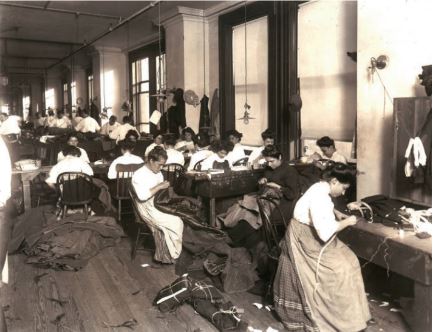
"Scraps of fabric accumulate throughout this garment factory during the course of a standard workday. It was scraps such as these that ignited the blaze at the Triangle Shirtwaist Factory" (Marsico, p. 13).
On March 25, 1911, a rag bin caught fire, possibly ignited by a cigarette. Joseph Granick said: “Eva Harris (she was the boss' sister) told me that she smelled smoke.” “I looked at the cutting tables. I saw through the slot the red flame” (Granick, 1958).
Cutter Max Rothen described, “Light scraps of burning fabric began to fly around the room; they came down on the other tables, and they fell on the machines” (Rothen, 1911).
Workers couldn't put out the fire due to a faulty hose. Forty-eight escaped through the elevator before it broke.
“I broke the window of the elevator door with my hands…I screamed, Fire! Fire! Fire! It was so hot we could scarcely breathe. When the elevator did stop, and the door opened at last, my dress was catching fire” (Sivos, p. 37).
“I stepped back into the building. I still had one foot on the fire escape when I heard a loud noise and looked back up. The people were falling all around me, screaming all around me. The fire escape was collapsing” (Gordon, 1958).
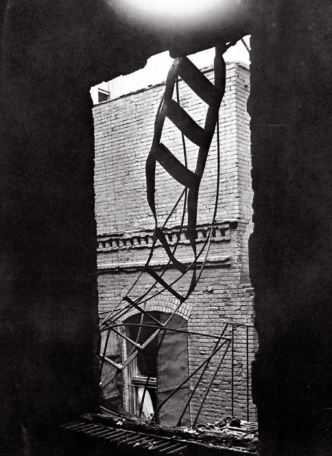
"The blazing inferno of the Triangle Shirtwaist Factory caused this fire escape ladder to twist and collapse under the intense heat of the flames and the weight of those trying to escape down its steps. Many workers dropped to their deaths" (Marsico, p. 34).
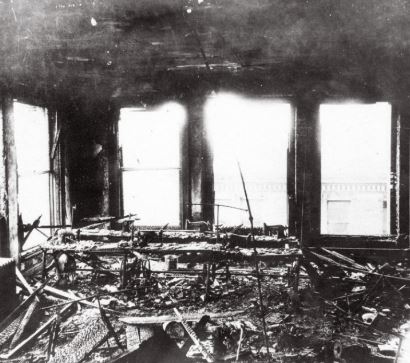
"This dramatic photo of the charred remains of the Triangle Shirtwaist Factory was taken after the flames were extinguished" (Marsico, p. 30).
Many died jumping in the elevator shaft or getting stuck behind staircases. Howard Ruch, NYFD Captain, said, “The fire was so intense it was impossible to stand up.” “We lay down on our stomachs to try to make it out the entrance. The eighth floor was a mass of fire” (Ruch, 1911).
Rose Glantz said, “We didn’t have a chance. The people on the eighth floor must have seen the fire start and grow. The people on the tenth floor got the warning over the telephone. But with us on the ninth, all of a sudden the fire was all around. The flames were coming in through many of the windows” (Stein, 1962).
Tragedy Summary (Story of Us: Triangle Shirtwaist Fire, 2011).
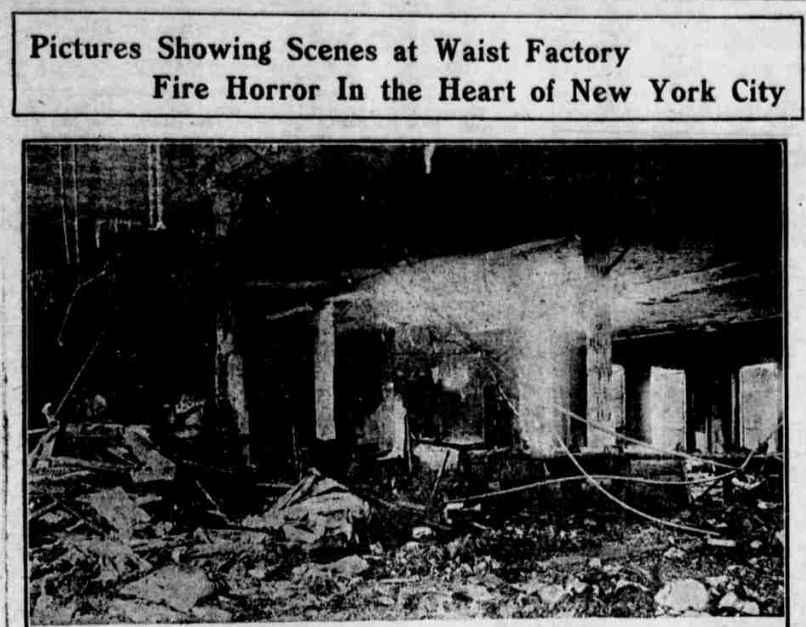
"Pictures Showing Scenes at Waist Factory - Fire Horror In the Heart of New York City" (The Logan Republican, 1911).
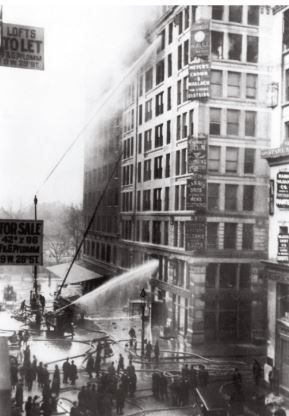
"Firefighters attempt to douse the flames of the burning Asch Building" (Marsico, p. 37).
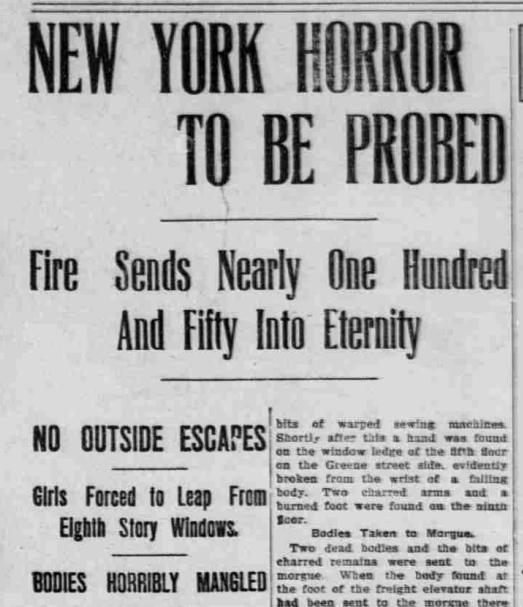
"Fire Sends Nearly One Hundred and Fifty into Eternity" (The Democratic Banner, March 28, 1911).
Short ladders and torn nets didn’t save jumping victims. 146 were killed
"Investigations with a view to fixing the blame for the horrible shirt waist factory fire in Now York city late Saturday afternoon have been set on foot. It is the belief of the district attorney that criminal negligence caused the fire, which resulted in the deaths of 142 persons, mostly girls and young women waist operatives, and the injury of many more. The ten story building at the northwest corner of Washington place and Greene street, only half a block from historic Washington square, is of the modern fireproof construction, yet the fire in the three upper floors, all occupied by the waistmakers, spread so rapidly that scores of the victims chose death by jumping from the windows rather than roast to death inside. The inflammable material for making waists and the furnishings of the plant were destroyed, the building itself being left practically intact save for the burning of the planking covering the concrete floors and the woodwork around the windows."
(The Logan Republican, April 20, 1911).